


Acetate vs. Acrylic for Custom Hair Clips: Which Material Wins for Your Brand?
The 30-Second Decision Guide
| Your Priority | Choose |
|---|---|
| Premium retail, high margins, repeat customers | Cellulose Acetate |
| Promotional giveaways, bulk orders, tight budget | Acrylic |
| Natural textures, durability, eco-friendly branding | Cellulose Acetate |
| Vibrant solid colors, mirror shine, fast delivery | Acrylic |
The Core Question
You have decided to launch custom hair clips for your brand. Now the material decision stands between you and production.
Acrylic and Cellulose Acetate are the two industry standards. They look similar in product photos. But in hand? On hair? After six months of use? The differences are dramatic—and they directly impact your return rate, customer reviews, and profit margins.
This guide uses factory test data, real client outcomes, and over ten years of DIYUE MIRACLE production experience to help you decide. No fluff. Just what you need to know.
Acrylic: Fast, Affordable, and High-Volume
What It Is
Acrylic (PMMA) is a petroleum-based synthetic resin. It is injection-molded or cut from sheets, then polished to a high-gloss finish.
Performance Data (Factory Tested)
| Metric | Acrylic Performance |
|---|---|
| Flexural strength | 80–100 MPa (rigid, low flexibility) |
| Impact resistance | Brittle—cracks under sudden force |
| Color retention | 12–18 months before surface dulling |
| Surface hardness | High (scratch-resistant initially) |
| Heat resistance | Deforms at 70–80°C |
What Brands Tell Us
Pros:
- Cost: 40–60% lower material cost than acetate
- Speed: 15–20 days from order to shipment
- Color range: 200+ solid and transparent options
- Printing compatibility: UV, laser, screen printing all work well
- Low MOQ: Samples from 100 pieces, bulk from 1,000 pieces per SKU
Cons (Real Client Feedback):
- "We had a 12% breakage rate during shipping to Europe." — US boutique buyer
- "Customers complained about the cold, plastic feel compared to our other accessories." — UK fashion brand
- "The clips started looking dull after eight months on store shelves." — Australian retailer
- "Not suitable for thick or curly hair—they snap under tension." — Hair stylist reviewer
Best Use Cases
- Brand promotional giveaways
- Corporate event souvenirs
- Student and youth collections
- Fast-fashion seasonal items
- Entry-level price points under $8 retail
Cellulose Acetate: Premium, Durable, and Brand-Building
What It Is
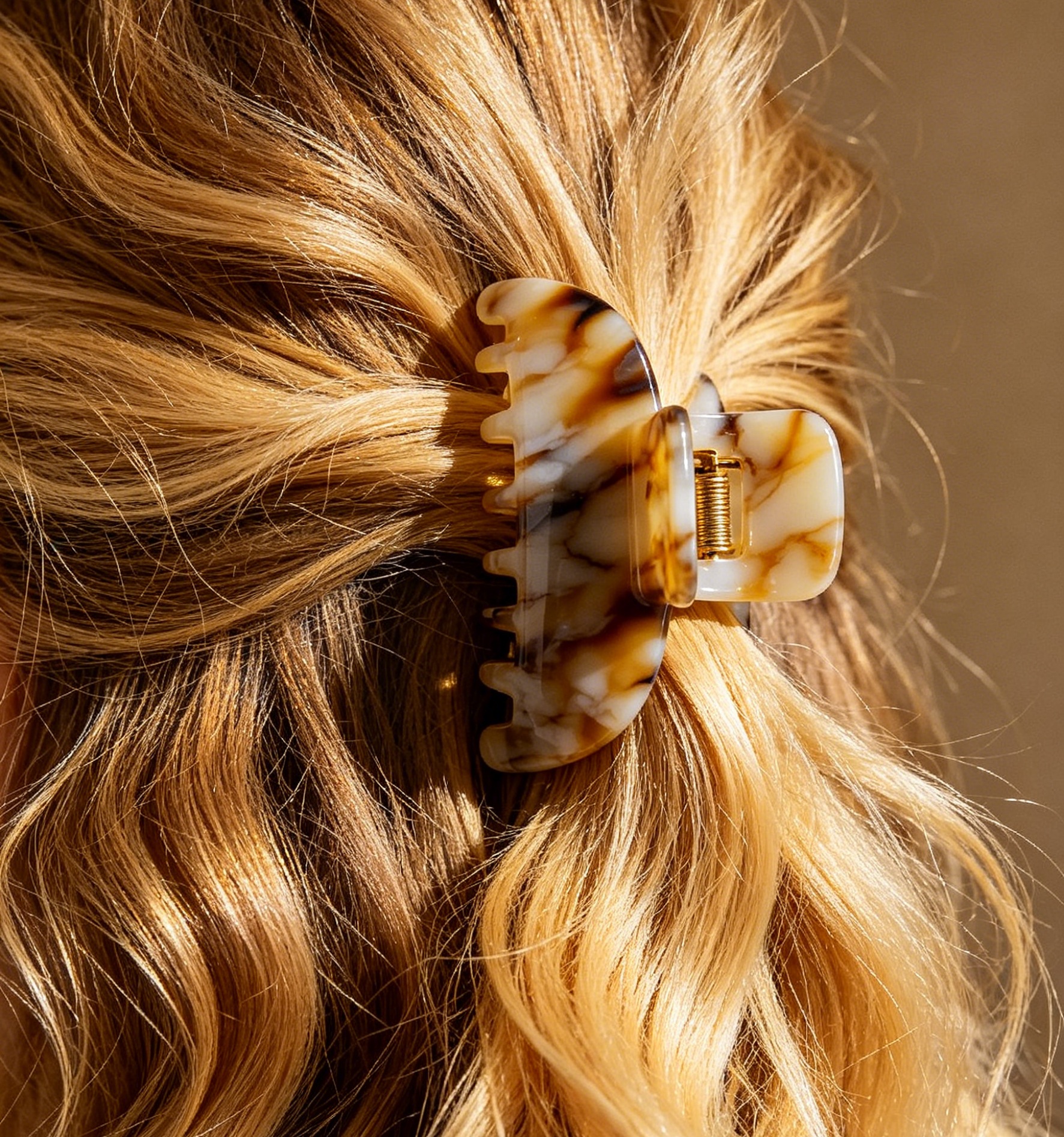
Cellulose acetate is derived from wood pulp and cotton linter—a plant-based, biodegradable material. Sheets are layered, cured for three to six weeks, then hand-cut and polished. Every piece is unique.
Performance Data (Factory Tested)
| Metric | Acetate Performance | Advantage over Acrylic |
|---|---|---|
| Flexural strength | 50–70 MPa (flexible, resilient) | Won't snap—bends under stress |
| Impact resistance | High—absorbs shock | 70% lower breakage in drop tests |
| Color retention | 3–5 years+ with proper care | 2–3x longer than acrylic |
| Surface feel | Warm, matte-luster, non-static | No hair pulling |
| Heat resistance | Stable up to 85–90°C | Better shelf stability |
What Brands Tell Us
Pros:
- Texture: Natural flow patterns—tortoiseshell, marble, gradient—are embedded in the material, not printed on top.
- Durability: "Our return rate dropped from 8% to under 1% after switching to acetate." — German online retailer
- Feel: "Customers describe it as warm and luxurious. We increased price from $12 to $28 and sales went up." — US accessories brand
- Eco-angle: Plant-based, biodegradable—appeals to EU consumers (73% say sustainability influences purchase decisions).
- MOQ: Accessible—300–500 pieces per SKU to start.
Cons:
- Cost: 2–3x acrylic material cost
- Lead time: 25–35 days (curing process takes time)
- Color limit: No pure transparent or high-mirror finishes
- Not for ultra-low budgets: Below $6 FOB, acrylic is usually the better call
Best Use Cases
- Boutique retail and luxury concessions
- Designer original collections
- Wedding favors and premium gift sets
- Brand signature products (long-term SKUs)
- Retail prices above $15–$20
Visual Comparison: What Your Customers Will Notice
| Feature | Acrylic | Cellulose Acetate |
|---|---|---|
| Surface shine | Mirror-like, reflective | Soft, warm luster |
| Texture depth | Surface-only | Embedded, layered |
| Pattern uniqueness | Uniform / repeating | Every piece unique |
| Aging over time | Dulls, may yellow | Maintains luster |
| Hand feel | Cold, light, hard | Warm, solid, smooth |
| Sound when tapped | Sharp "click" | Dull "thud" |
Two Real-World Case Studies
Case 1: UK Boutique Chain (12 stores)
Challenge: Existing acrylic clips had a 9% return rate due to breakage. The brand wanted to reposition as sustainable luxury.
Solution: Switched to acetate for all core collections. Added plant-based material to packaging.
Results (six months):
- Return rate: 9% → 0.8%
- Average retail price: £14 → £26
- Sell-through rate: 61% → 89%
- Customer reviews: "cheap" → "worth every penny"
Case 2: US Promotional Agency
Challenge: 10,000 pieces of branded clips for a tech company event. Three-week deadline. Budget $2.50 per piece FOB.
Solution: Acrylic custom clips with laser-engraved logo.
Results:
- Delivered in 18 days
- Within budget
- Client re-ordered for three more events
- Breakage: under 2% (acceptable for giveaway items)
How to Spot Fake Acetate
Some suppliers print acetate-like patterns on acrylic. Here are three factory-proven checks:
| Test | Fake (Acrylic) | Real (Cellulose Acetate) |
|---|---|---|
| Bend test | Bends 5–10° then snaps | Bends 30°+ and springs back |
| Heat test (warm water) | No change | Slight softening, returns when cooled |
| Edge shine | Glassy, reflective | Warm, satin-like |
| Pattern | Perfectly repeating | Organic, random layers |
DIYUE MIRACLE: We Make Both. Here Is Our Honest Advice.
We manufacture both acrylic and acetate hair clips. We have no incentive to push one over the other—except to help you succeed.
Choose Acrylic if:
- Your order is for promotion, giveaway, or seasonal trend
- Your retail price target is under $10
- You need delivery in under 25 days
- Your budget per unit is under $3 FOB
Choose Acetate if:
- You are building a long-term brand product
- Your retail price is $15+ and you want to defend that price
- Customer experience and word-of-mouth matter more than upfront savings
- You want to tell a sustainability story
Choose Both if:
- You are launching a tiered collection: acrylic for entry-level, acetate for premium
- You want to test market response before committing fully
Our Capabilities at a Glance
| Service | Acrylic | Cellulose Acetate |
|---|---|---|
| Custom shapes | Yes | Yes |
| Custom colors | Yes (match any Pantone) | Yes (from color sheets) |
| Logo engraving | Yes (laser) | Yes (laser) |
| UV full-color printing | Yes | Not recommended |
| MOQ (sample) | 1 pieces | 1 pieces |
| MOQ (bulk) | 1,000 pieces per SKU | 500 pieces per SKU |
| Lead time | 15–20 days | 25–35 days |
Request a Material Comparison Kit
Not sure which material fits your brand? We make it easy.
Contact us to request a curated selection of our in-stock products, including:
- Three in-stock acrylic clips (different finishes)
- Three in-stock acetate clips (different textures and colors)
This hands-on comparison kit lets you feel the difference in weight, texture, and durability—side by side—before you commit to production. No design files needed.
Get it here: info@diyuemiracle.com
Quick Quote: Send your design and quantity—we will reply within 24 hours.
About DIYUE MIRACLE: Over ten years in hair accessory manufacturing and export. Certified ISO 9001, BSCI, REACH-compliant. We have delivered over two million custom clips to brands across the United States, United Kingdom, Germany, France, Australia, and Canada.
FAQ
Q: Can I mix acetate and acrylic in one order?
A: Yes. We frequently produce mixed collections for brands testing both materials.
Q: Which material is better for heavy or thick hair?
A: Acetate. Its flexural resilience means it will not snap under tension. Acrylic is more prone to breaking in this use case.
Q: What is the price difference exactly?
A: Acetate FOB prices typically range $2.50–$5.00 per piece (depending on size and complexity), while acrylic ranges $0.80–$2.50 per piece. Volume discounts apply.
Q: Do you handle packaging and logistics?
A: Yes. We offer custom packaging design and arrange shipping to any global destination.
This article was last updated June 2026.